

“MGM Resorts” isn’t a single hotel you check into — it’s a hospitality company that owns and operates a portfolio of distinct properties, mostly concentrated on the Las Vegas Strip but stretching into regional markets and overseas as well. That distinction matters more than it might seem, because it means the answer to “what’s dining or gaming like at MGM Resorts” genuinely depends on which specific property you’re talking about. Understanding the portfolio structure first makes it much easier to actually plan a trip, rather than treating the brand name as one uniform experience.
What MGM Resorts International Actually Is
MGM Resorts International grew out of the original MGM Grand company through a series of acquisitions and rebrands, eventually taking on its current name in 2010 to reflect its expansion well beyond a single Las Vegas property. Today it operates dozens of properties, the bulk of them clustered on or near the Las Vegas Strip, alongside regional casino resorts in markets like Atlantic City, Detroit, National Harbor in Maryland, and Springfield, Massachusetts, plus an international presence in Macau. Several of the company’s flagship Las Vegas properties — Bellagio, MGM Grand, Aria, Mandalay Bay, and Luxor among them — are each large enough and different enough in character that choosing between them is really choosing between different vacations, not different room types at the same hotel.
Why the Property You Pick Changes the Whole Experience
Each flagship property has its own identity, and that identity shapes dining, gaming, and relaxation far more than the shared MGM ownership does. Bellagio leans into classic, old-world luxury — five-star service, the famous choreographed fountain show out front, and a dining and spa scene built around refinement rather than spectacle. Aria, part of the newer CityCenter development on the Strip, takes a more contemporary approach, with sleek architecture and a dining lineup that leans toward variety and buzz rather than tradition. MGM Grand positions itself as the entertainment-forward option, anchored by a major arena that hosts concerts, boxing, and other large events, alongside a nightlife scene built around clubs and lounges. Mandalay Bay and Luxor, at the south end of the Strip, trade some of the density of the middle-Strip properties for more space — larger pool complexes and a slightly different pace. None of this is better or worse across the board; it just means “MGM Resorts” is really a menu of different vacation styles wearing the same corporate name.
How Dining Actually Varies by Property
Every major MGM property runs a tiered dining approach: a handful of upscale, reservation-worthy restaurants often associated with well-known chefs, a broader layer of mid-range options covering steakhouses, Asian cuisine, and Italian, and then casual food halls or grab-and-go spots for anyone who doesn’t want to sit down for a full meal. What differs between properties is the specific lineup and the overall tone — Bellagio’s fine-dining scene tends toward a more formal, occasion-driven feel, while a property like Aria tilts toward trendier, higher-energy dining rooms. The practical takeaway is that “MGM dining” isn’t a fixed list you can memorize — it’s worth looking at what’s currently operating at your specific property before your trip, since restaurant lineups do change over time as leases and chef partnerships evolve.
How the Gaming Floors Compare
Every flagship property runs a full casino floor, but the atmosphere and game mix aren’t identical across the portfolio. Larger properties like MGM Grand and Aria tend to have bigger, more varied floors with a wide spread of slot denominations and table game limits, which generally means more room to find a table that matches your comfort level, whether that’s a low-stakes blackjack table or a higher-limit room. Bellagio has historically leaned into a slightly more upscale, quieter gaming atmosphere consistent with its overall brand positioning. Poker rooms, when available, run scheduled tournaments and cash games, and it’s worth checking a specific property’s current poker schedule directly rather than assuming availability, since not every property runs a poker room at all times. If gaming variety and game selection matter more to your trip than anything else, it’s worth comparing a couple of specific casino floors rather than assuming they’re interchangeable just because they share a parent company.
Where Relaxation and Entertainment Fit In
Spas, pools, and shows round out what most people actually associate with a Vegas resort stay, and here too the specific property matters. Spa offerings generally include standard treatments — massages, facials, and body treatments — but the setting and scale vary from an intimate, quieter spa experience at a smaller property to a large, resort-style spa and salon complex at a flagship like Bellagio or Aria. Pool complexes range from expansive, multi-pool layouts with cabanas and bars at properties like MGM Grand and Mandalay Bay to more compact, design-forward pool decks elsewhere. Entertainment bookings — Cirque du Soleil-style productions, residencies, and touring shows — rotate between venues and change over time, so it’s worth checking a specific property’s current show calendar rather than assuming a particular production will still be running when you visit.

Making the Most of a Multi-Property Trip
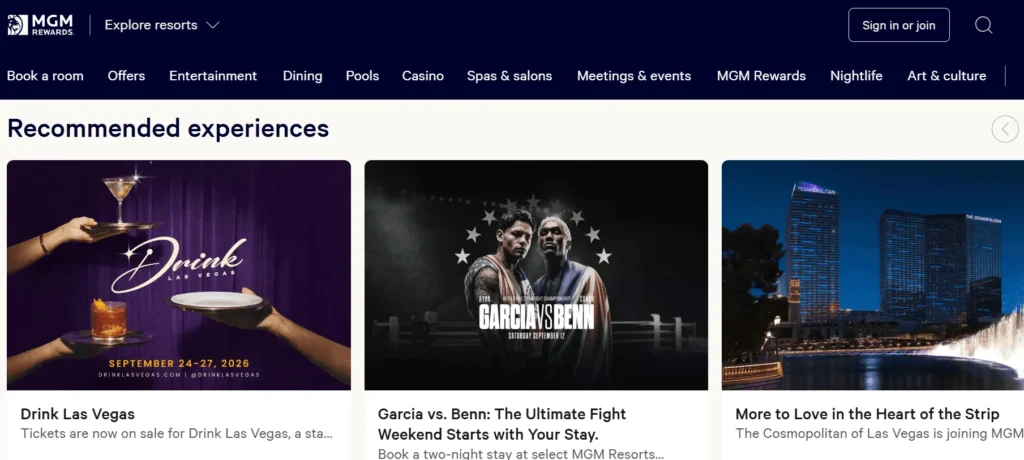
Because these properties sit close together on the Strip, one of the more practical things to know is that staying at one MGM property doesn’t lock you out of the others — many guests split their time, dining at one property, gambling at another, and catching a show somewhere else entirely, especially since several flagship resorts are connected or a short walk from one another. MGM’s loyalty program also applies across the portfolio rather than being tied to a single hotel, so points, tier status, and certain perks generally carry over whichever property you’re spending time at, which is worth signing up for even if you’re not sure yet which specific resort you’ll book. Booking key restaurant reservations and any major show tickets in advance is worth doing regardless of which property you choose, since the most in-demand spots at any flagship resort tend to fill up well before a trip, particularly around weekends and major events.
Final Thoughts
The most useful way to think about MGM Resorts isn’t as one destination but as a cluster of related ones, each with its own personality, dining scene, and pace. Bellagio suits a more refined, classic Vegas trip; Aria and MGM Grand lean into energy and entertainment; Mandalay Bay and Luxor offer more space and a slightly different rhythm. Picking the property that actually matches what you want out of the trip — rather than just booking whichever one comes up first — is the real key to getting the dining, gaming, and relaxation experience you’re actually after.